Where's the Water?
A builder's case for California's water crisis.

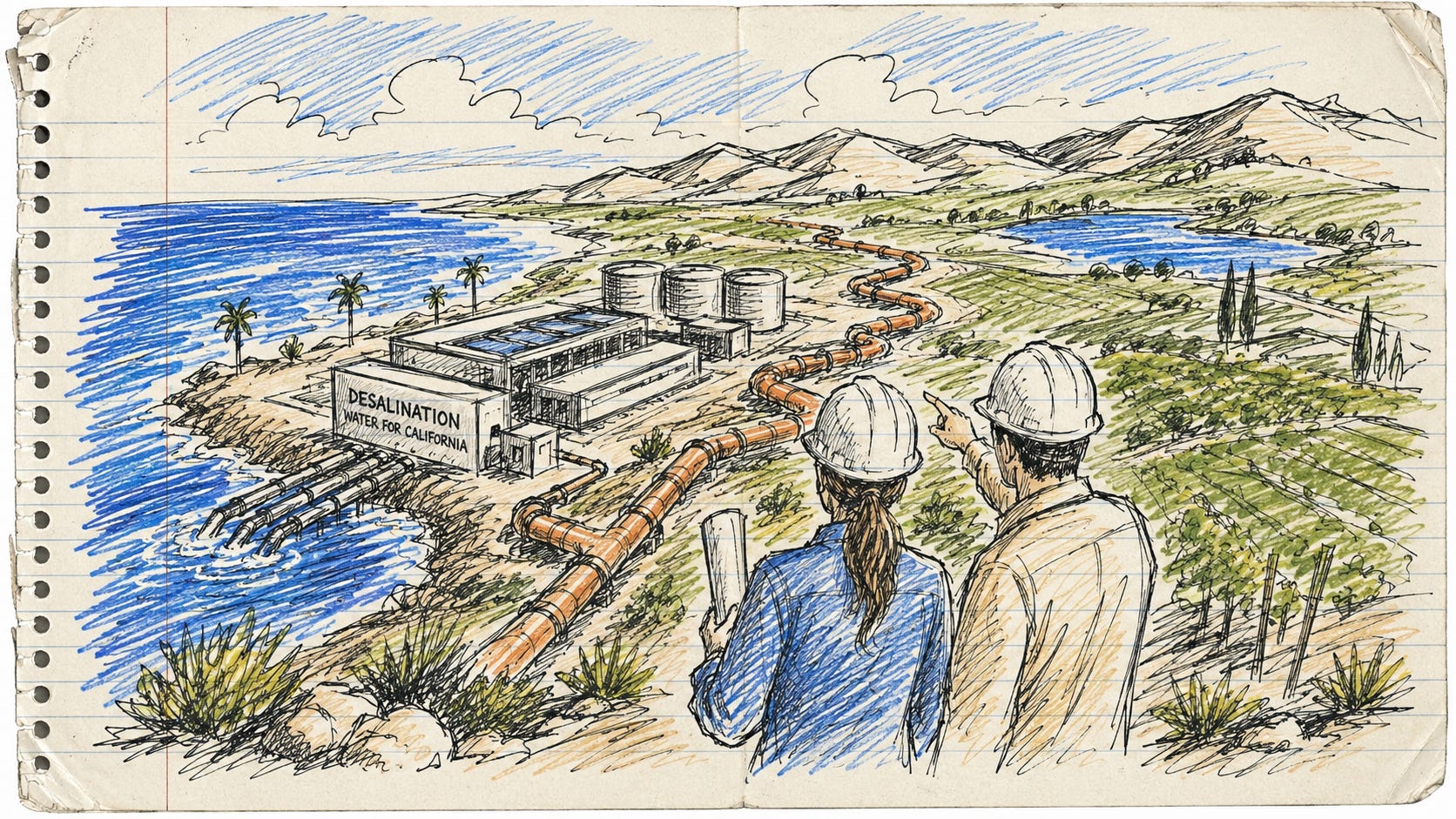
For the first time in twenty-five years, no part of California is officially in drought.
That sounds like good news. It isn’t.
Three wet years (2023, 2024, 2025) refilled the reservoirs. Shasta, Oroville, Trinity, and New Melones are all above their historical averages. The Drought Monitor shows the state in clean white for the first time since 2000.¹
And yet:
· The Central Valley has lost roughly 36 million acre-feet of groundwater since 2003, draining the equivalent of Lake Mead 1.3 times over.² Depletion is now running 31% faster in the post-2019 megadrought than in either of the prior dry stretches.³
· In March 2026 alone, a record heatwave melted approximately 5 million acre-feet of Sierra snow in a single month. Statewide snowpack collapsed to 18% of average even though winter precipitation was close to normal. The frozen reservoir we’d been counting on is at the lowest level ever recorded.⁴
· In 2022, California farmers idled 752,000 acres of cropland and lost $1.7 billion in crop revenue to water scarcity. The drought is “over.” The structural overdraft isn’t.⁵
The surface story changed. The groundwater story didn’t.
But this isn’t really a water story. It’s a story about whether we still know how to build. The water just happens to be where the math is most obvious.
Where the Crisis Lives
California uses about 40 million acre-feet of water per year, split roughly 50% environmental, 40% agricultural, 10% urban.⁶ Environmental allocations keep rivers running and wetlands wet. Some readers will object to that share. I’d ask them to consider what California looks like without it.
The crisis lives in the aquifer.
In the most overdrafted basins, Tulare and San Joaquin, water tables have dropped by more than 100 feet since 2000. Farmers chase the water down. Ag wells now average 450 to 600 feet, with the deepest pushing 2,000.⁷
The Sustainable Groundwater Management Act was supposed to fix this. It hasn’t, yet.
A decade in, the first basin ever put on formal probation is still fighting it in court.⁸ Policy alone isn’t going to refill an aquifer.
The land itself records the deficit. The San Joaquin Valley has sunk roughly 28 feet since the 1920s, with hot spots still subsiding up to 2 feet per year.⁹ The State Water Project has lost about 3% of its delivery capacity. The Avenal section of the California Aqueduct now carries 20% less than it was designed to.¹⁰
You can refill the surface reservoirs in a wet year. You can’t refill an aquifer that the land itself collapsed on top of.
Why We Keep Looking Inland
I hadn’t thought much about any of this until last summer.
Driving the eastern Sierra, I learned that the water rights for that land belong to Los Angeles County, 100 to 200 miles south. Los Angeles is on the Pacific Ocean. It pulls its water from a region that is literally sinking from groundwater depletion.
That is the entire problem, in one sentence.
Over 55% of California’s population lives in coastal counties. About 90% of urban water still comes from inland river diversions and groundwater.¹¹ California is the fourth-largest economy on Earth. The fourth-largest economy doesn’t pipe its drinking water from a valley 200 miles away that is literally collapsing into the ground.
It’s time to look at the ocean.
Nine Plants
I propose a network of nine seawater desalination plants, each comparable to Israel’s Sorek facility, serving the coastal population from the Bay Area to San Diego.
1. San Francisco Peninsula, near Daly City or South San Francisco
2. East Bay North, near Berkeley Marina
3. East Bay South, near Hayward
4. South Bay, serving San Jose and Silicon Valley
5. Los Angeles, Manhattan Beach
6. Los Angeles, Long Beach (near existing port facilities)
7. Los Angeles, second Manhattan Beach site for operational redundancy
8. San Diego North, near Oceanside (new facility)
9. San Diego, ~3x expansion of the existing Bud Lewis plant at Carlsbad (from ~190,000 to ~600,000 m³/day)
Each plant produces about 600,000 cubic meters per day, which works out to roughly 177,500 acre-feet per year. Across all nine: ~1.6 million acre-feet annually.¹² Roughly equal to the volume the Central Valley aquifer loses to overdraft each year, and enough to cover the urban water demand of California’s three biggest metros combined.
Coverage
San Diego: 2 plants, ~355,000 AF/year (~118% of municipal demand)
Los Angeles: 3 plants, ~533,000 AF/year (~89%)
Bay Area: 4 plants, ~710,000 AF/year (~95%)
Drawn from a source that doesn’t care whether it rained.
The point of this isn’t to replace inland water. The point is to free it. Every acre-foot pulled from the Pacific is an acre-foot not pulled from the aquifer, not pulled from the Owens Valley, not diverted from a river. Coastal desalination becomes the marginal supply that lets the groundwater finally recover.
That’s the trade. Pay the capex once, or pay the wildfire, ag, and infrastructure bills forever.
This is just terraforming. We’re good at it.
The Power Question
These plants need clean, reliable, around-the-clock electricity. Roughly 86 to 93 megawatts per plant, or about 770 to 840 MW for the whole network. That’s about one-third of Diablo Canyon’s output.¹³
The proposal does not depend on a specific power source. Any clean baseload that can deliver this load works. Grid power backed by solar, wind, and natural gas can run the network on Day One.
But small modular reactors are the long-term ideal pairing. Drought-proof water needs drought-proof power, and sixty years of stable clean baseload is the right energy profile for desalination.
That said, I want to be honest about where SMRs are.
As of May 2026, there are zero operating commercial SMRs in the United States. NuScale’s flagship 77 MWe design received NRC Standard Design Approval in May 2025, but its anchor project with UAMPS in Idaho was cancelled in November 2023 after overnight capital costs rose to over $20,000/kW.¹⁴ TerraPower broke ground on its Natrium reactor in Wyoming in April 2026, the first new construction permit issued for a non-light-water reactor in NRC history.¹⁵ Kairos and Holtec are in earlier stages.
Realistic first-of-kind SMR capex is currently $10,000 to $20,000 per kilowatt, four to five times the figure quoted in optimistic SMR marketing decks.¹⁶
For our 840 MW load: roughly $10 to $13 billion in nuclear capex if we pair from Day One. Build the desal network first and add SMRs in phases as costs come down, and that number flexes.
The desalination network is the project. The power source is the optimization.
The Bill
Honest project total, using 2026 numbers:
9 desalination plants @ $2.5-3B each (CA labor + permitting premium over Sorek’s $1.5B): $22-27B
~840 MW SMR power @ $12-15K/kW realistic first-of-kind: $10-13B
Pipelines, brine outfalls, grid interconnects: $3-5B
20% contingency (this is California, see: high-speed rail): $7-9B
Total: $42-54B
Revenue, using Carlsbad’s current wholesale price of about $2,800 per acre-foot:¹⁷
1.6M AF/yr × $2,800/AF = ~$4.5 billion per year
Gross payback period, before opex and financing, is roughly 10 years. Realistic levered payback, more like 15 to 20.
Now compare to the cost of doing nothing.
The UC Davis and UC Merced research center, in a May 2025 study commissioned by the California Municipal Utilities Association, estimated the economic cost of inaction on California water at $3.4 to $14.5 billion per year, with potential losses of up to 9 million acre-feet of supply by 2050 and 67,000 jobs at risk.¹⁸ Project that out 25 years and you get $85 to $360 billion in cumulative loss, which brackets the “$200-300 billion” figure I’d seen elsewhere.
For comparison: the Pacific Palisades and Eaton wildfires of January 2025 caused approximately $250 to $275 billion in total economic damage and roughly $40 billion in insured losses, the costliest US wildfire event ever recorded.¹⁹ That’s a single month.
A $45 billion infrastructure project that prevents even a fraction of that, while replacing the urban water demand of California’s three biggest metros, is not a stretch. It’s an obvious trade. The math works even if you assume the costs go up further from here.
This Is Not Exotic
The Middle East has spent two decades making itself drought-proof. We can copy this.
Israel made the decision in the early 2000s, when the Sea of Galilee hit record lows. Over the next fifteen years they built five major desalination plants on the Mediterranean coast. Today, 86% of their drinking water comes from the ocean.²⁰
A country with one-tenth California’s coastline.
Saudi Arabia and the UAE followed. Jubail 3A, a plant the size of the ones I’m proposing, came online in 2023 for $658 million. Taweelah in the UAE is now the world’s largest reverse-osmosis facility. The Gulf drinks from the sea.²¹²²
Australia is proof a democracy can move this fast too. After the Millennium drought, they built a national desalination network in under a decade. Melbourne’s plant alone covers a third of the city’s water.²³
Each of those countries faced a smaller economy, a smaller coastline, or a smaller crisis than California’s. Each chose to build. We’ve been holding meetings.
And we used to know how to do this. The Hoover Dam was completed in 1936, two years ahead of schedule, in the middle of the Great Depression. Five years from groundbreaking to ribbon-cutting. About $1 billion in today’s dollars.²⁴ It made Los Angeles, Phoenix, and Las Vegas possible.
The Interstate Highway System took 36 years and $128 billion. We didn’t stop through wars, recessions, or oil shocks.²⁵
The California State Water Project, in the 1960s and 70s, moved a river to power the modern California economy.
We are not historically incapable of large infrastructure. We just stopped trying.
The political will is finally back. SB 72 (2025) made nine million acre-feet a state-law target.²⁶ Doheny got EPA approval in March 2026, CalAm cleared CPUC in August 2025, Marina Coast comes online 2027.²⁷
What policy should do next is get out of the way faster. Fast-track permitting for private builders is the highest-leverage move Sacramento has left.
Policy doesn’t scale. Markets do, when permits move at the speed of capital.
How to Start
I’d propose this sequence:
1. 2027-2028: Approve and fund a single demonstration plant at Carlsbad. The existing facility, the SDCWA off-take contract, and a wholesale water price that already pencils make it the obvious site. Budget $4-6B, half public, half private.
2. 2029-2032: Build it. Use the first-of-kind to drive down the SMR cost curve and to expose every CEQA, Coastal Commission, and brine-discharge issue we’ll need to resolve at scale.
3. 2033-2040: Scale the remaining eight plants in pairs, each pair informed by the operating data from the last.
4. 2040: ~1.6M AF/yr of drought-proof urban supply. Groundwater allowed to actually recover. SGMA targets reachable without fallowing 3 million additional acres.²⁸
To the Builders
California’s water crisis didn’t end with the drought. It just got harder to see.
The political incentives to act fade exactly when the reservoirs refill. That’s the trap. Every wet year is an opportunity for inaction, and inaction is what got the aquifers into their current state.
The ocean is right there. The technology exists. The cost is large but real, and it is dwarfed by the cost of mining an aquifer that took millennia to fill and is being drained in decades.
And the pieces have never been better aligned. SB 72 made nine million acre-feet of new supply a state-law target, not an aspiration. The Coastal Commission has a settled regulatory path for brine. DOE Loan Programs Office Title 17 has roughly $5 billion in remaining advanced-energy loan authority, plus another $2.47 billion through the Advanced Reactor Demonstration Program with a 1:1 private match. Both sunset September 30, 2026.²⁹
State law. Federal capital. Regulatory path. Known buyer. The only thing missing is a check.
A Carlsbad demonstration plant. Four to six billion dollars. Half public, half private, SDCWA on the offtake. That’s the project. It pencils today. It pays back in a decade. It scales to nine plants and 1.6 million acre-feet a year by 2040.
If American Dynamism means anything, it means this.
Andreessen Horowitz. Founders Fund. Khosla. Breakthrough Energy. Someone writes the first check, the rest follow.
We can keep going instead. The land will keep sinking, the wells will keep going deeper, the snowpack will keep collapsing earlier, and at some point the cost of inaction passes the cost of action and the choice is made for us, badly.
Or we can build it.
Israel did it in 15 years. Australia in 10. We did Hoover in 5.
Time to do it again.
Sources
¹ CalMatters, California Drought Tracker (accessed May 2026). https://calmatters.org/california-drought-monitor/
² PPIC, “Groundwater in California” (2024). https://www.ppic.org/publication/groundwater-in-california/
³ CA DWR, “Subsidence and Groundwater Over-Pumping Could Limit Future Water Deliveries,” study release May 2025. https://water.ca.gov/News/Blog/2025/May-25/Study-Finds-That-Subsidence-Groundwater-Over-Pumping-Could-Limit-Future-Water-Deliveries
⁴ CalMatters, “California heat wave melts Sierra snowpack two months early,” March 2026. https://calmatters.org/environment/water/2026/03/california-heat-wave-snow-reservoirs/
⁵ PPIC, “Drought and California’s Agriculture” (2022 fallowing data); UC Merced, “Economic Impacts of the 2020-22 Drought.” https://www.ppic.org/publication/policy-brief-drought-and-californias-agriculture/
⁶ PPIC, “Water Use in California.” https://www.ppic.org/publication/water-use-in-california/
⁷ California well industry statistics; CA DWR groundwater monitoring data.
⁸ Maven’s Notebook, “State Water Board Restarts Sanctions Against Tulare Lake Subbasin,” November 2025. https://mavensnotebook.com/2025/11/01/sjv-water-groundwater-agencies-squabble-as-state-announces-restart-of-sanctions-against-tulare-lake-subbasin/
⁹ NASA JPL, “NASA Data Show California’s San Joaquin Valley Still Sinking.” https://www.jpl.nasa.gov/news/nasa-data-show-californias-san-joaquin-valley-still-sinking/
¹⁰ Stanford News, “Groundwater pumping drives rapid sinking in California,” November 2024. https://news.stanford.edu/stories/2024/11/groundwater-pumping-drives-rapid-sinking-in-california
¹¹ CA Department of Water Resources, State Water Project documentation. https://water.ca.gov/
¹² Conversion: 600,000 m³/day × 365 ÷ 1,233.48 m³/AF = ~177,500 AF/year per plant. Sorek 1, the comparable Israeli facility, produces ~624,000 m³/day.
¹³ Diablo Canyon nameplate capacity: 2,256 MW. World Nuclear Association. https://www.world-nuclear.org/
¹⁴ U.S. Department of Energy, “NRC Approves NuScale Power’s Uprated Small Modular Reactor Design,” May 2025. https://www.energy.gov/ne/articles/nrc-approves-nuscale-powers-uprated-small-modular-reactor-design ; American Public Power Association, “UAMPS, NuScale Power Agree to Terminate Carbon Free Power Project,” November 2023. https://www.publicpower.org/periodical/article/uamps-nuscale-power-agree-terminate-carbon-free-power-project
¹⁵ Idaho Capital Sun, “TerraPower breaks ground on a rarity, a nuclear reactor: Wyoming’s first,” April 2026. https://idahocapitalsun.com/2026/04/23/terrapower-breaks-ground-on-a-rarity-a-nuclear-reactor-wyomings-first/
¹⁶ IEEFA, “Eye-popping new cost estimates released for NuScale small modular reactor.” https://ieefa.org/resources/eye-popping-new-cost-estimates-released-nuscale-small-modular-reactor ; Ontario BWRX-300 project cost data: ~CAD $20.9B for 1,200 MW (~USD $12,800/kW).
¹⁷ Voice of San Diego, “San Diegans Owe a Desal Company $35 Million for Unmade Water,” September 2025. https://voiceofsandiego.org/2025/09/22/san-diegans-owe-a-desal-company-35-million-for-unmade-water/
¹⁸ UC Davis, “California Risks Billions in Economic Losses Without Water Supply Action,” May 2025. https://www.ucdavis.edu/climate/blog/california-risks-billions-economic-losses-without-water-supply-action
¹⁹ AccuWeather, revised estimate of $250-275B in total damage from January 2025 Los Angeles wildfires. https://www.accuweather.com/en/weather-news/accuweather-estimates-more-than-250-billion-in-damages-and-economic-loss-from-la-wildfires/1733821 ; Swiss Re insured-loss estimate ~$40B.
²⁰ Times of Israel, “Israel rides out drought with desalination.” https://www.timesofisrael.com/israel-rides-out-drought-with-desalination/
²¹ Zawya, “Saudi Arabia’s $650mln Jubail 3A desalination plant commences full operation.” https://www.zawya.com/en/projects/utilities/saudi-arabias-650mln-jubail-3a-desalination-plant-commences-full-operation-mexj58iw
²² Zawya, “EWEC’s Taweelah RO facility sets new record surpassing 90% capacity.” https://www.zawya.com/en/projects/utilities/ewecs-taweelah-ro-facility-sets-new-record-surpassing-90-capacity-qxgx8u6p
²³ The Conversation, “Cities turn to desalination for water security, but at what cost?” https://theconversation.com/cities-turn-to-desalination-for-water-security-but-at-what-cost-110972
²⁴ U.S. Bureau of Reclamation, Hoover Dam FAQ. https://www.usbr.gov/lc/hooverdam/faqs/damfaqs.html
²⁵ Federal Highway Administration, Interstate History. https://www.fhwa.dot.gov/highwayhistory/data/page03.cfm
²⁶ State of California, “California is more prepared for our water future than ever before,” May 2026 (covering SB 72 implementation). https://www.gov.ca.gov/2026/05/07/california-is-more-prepared-for-our-water-future-than-ever-before/
²⁷ California City News, “New Desalination Plant Approved Orange County,” March 2026, https://californiacitynews.org/2026/03/new-desalination-plant-approved-orange-county.html ; American Water press release, “CPUC Approves Water Supply Decision Supporting California American Water’s Monterey Peninsula Desalination Project,” August 2025, https://www.amwater.com/press-room/press-releases/california/california-public-utilities-commission-approves-water-supply-decision-supporting-california-american-waters-monterey-peninsula-desalination-project ; CA Water Boards desalination guidance, https://www.waterboards.ca.gov/water_issues/programs/ocean/desalination/
²⁸ PPIC, “The Future of Agriculture in the San Joaquin Valley” (up to 1M acres at risk by 2040); UC Davis/UC Merced May 2025 study (up to 3M acres fallowed by 2050 under inaction scenario).
²⁹ National Law Review, “Nuclear Power in 2025: DOE Loan Programs Office (LPO) at Forefront.” https://natlawreview.com/article/nuclear-power-in-2025-doe-loan-programs-office-lpo-forefront ; DOE Advanced Reactor Demonstration Program. https://www.energy.gov/ne/advanced-reactor-demonstration-program